Kyrgyz food is nomad food with a century of neighbours mixed in. The core is meat and dairy: mutton, beef and horse boiled, fried or dried, and milk turned into cream, dried yoghurt balls and a fizzy fermented drink. Around that sit the dishes of the farming valleys, plov, samsa and layered breads, and the noodles of the Dungan and Uyghur communities who came from western China in the 19th century.
This list runs from the dishes you will be served at a family table to the ones you order at a chaikhana or buy from a tandyr on the street. For each we say what it is, when people eat it, what to order it with and where to find it, with a 2026 price wherever one is published. Bishkek cafe prices rose by about 30 percent after a law banned the old service charge from 1 January 2026, so treat anything older as out of date.
Most pins are in Bishkek, with Karakol for ashlan-fu and the Suusamyr valley for kumis. For restaurant picks beyond these, see our Bishkek restaurants guide, and for the bazaars where you can eat half this list in one morning, the Osh Bazaar entry in our Bishkek guide.
Map of where to eat it
Meat and the big plates
The dishes a Kyrgyz family cooks when there is something to celebrate, and the ones every chaikhana has on the menu.
1Beshbarmak
The national dish: boiled meat over noodles, eaten by hand
Beshbarmak means five fingers, because you eat it with your hand. Meat, usually mutton but also beef or horse, is boiled for hours, chopped fine (the Kyrgyz name tuuralgan et means chopped meat) and spread over thin squares of home-made noodle, then dressed with chyk, sliced onion simmered in the fatty broth with black pepper. At a feast the slices of chuchuk horse sausage go on top. In the north it comes after a bowl of shorpo broth, and ak-serke follows it.
The dish is a ritual as much as a meal. A sheep gives twelve ustukan, bone-in cuts in a strict order of prestige, and each goes to a named person: the pelvic bone to the eldest, the tailbone to the most respected woman, the head to the guest of honour, who cuts pieces from it and shares them. It is cooked for births, big birthdays, weddings and funerals, and in March 2018 about 40 cooks in Bishkek made a 1,464-kilogram beshbarmak that Guinness listed as the largest serving, with a 117-metre chuchuk on the side.
Our pick in Bishkek is Sonoon on Orozbekova, which has beshbarmak and a house plov on a menu that runs 11:00 to midnight; we found no published price there. For scale, the Gurman cafe lists a 500-gram portion at 500 som on its delivery menu (November 2026), and cooking it at home for six cost about 1,250 som in ingredients before Nooruz 2025.
- Price
- 500 som for 500 g at Gurman cafe (November 2026)
- Eat it
- With your right hand, after the shorpo
- Record
- 1,464 kg in Bishkek, 11 March 2018
- Where
- Sonoon, Orozbekova 62, BishkekOpen in Maps
Details checked November 2026
View this post on Instagram
2Kuurdak
Fried meat, onion and potato from the kazan
Kuurdak comes from kuuruu, to fry: chunks of mutton, beef, horse or offal fried in the animal’s own fat with onion in a kazan, and in Kyrgyzstan with potato, which is the local signature. Meat-only is kara kuurdak; the offal version uses liver, kidney, lungs and heart. It began as a nomad’s way of dealing with a freshly slaughtered sheep, and meat fried in rendered fat was sealed in a dried stomach to carry between pastures, which is why it is the dish you get first when a family slaughters an animal.
It is on every chaikhana menu and is the easiest Kyrgyz dish to love: salty, oniony, with the potato soaked in fat. Navat lists a 530-gram home-style kuurdak at 875 som and Mubarak a 600-gram one at 780 som (November 2026). Our pick is Maarek on the 17th floor on Razzakov, whose menu is built around kuurdak, bai kazan and smoked chuchuk.
- Price
- 875 som for 530 g at Navat; 780 som for 600 g at Mubarak (November 2026)
- Ask for
- Kara kuurdak if you want meat only
- Where
- Maarek, Razzakov 19, BishkekOpen in Maps
Details checked November 2026
View this post on Instagram
3Shorpo
The clear mutton broth that starts the meal
Shorpo is a strong, clear mutton broth with a big piece of meat on the bone, potato, carrot and more onion than any other soup. The word comes through Persian, shor for salty and ba for a liquid dish, and it is shurpa everywhere else in Central Asia. There are two ways to make it: kainatma, with everything boiled, and kuurma, with the meat and vegetables fried first.
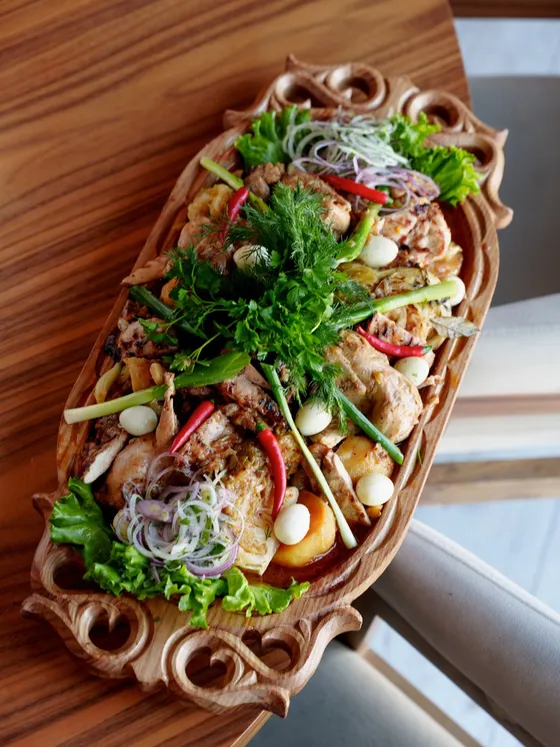
In Kyrgyzstan it is the opener. A northern beshbarmak meal starts with a bowl of shorpo, and on a cold day it is a meal on its own with bread. A portion is 425 som at Navat, 420 at Mubarak and 390 at the Gurman cafe (November 2026). Sonoon makes a dressed-up house version, pictured here.
- Price
- 390–425 som a bowl in Bishkek (November 2026)
- Order with
- Tandyr bread, then beshbarmak
- Where
- Navat chaikhana, Ibraimova 40, BishkekOpen in Maps
Details checked November 2026
View this post on Instagram
4Chuchuk and kazy
Horse-meat sausage, the most prized thing on the table
Chuchuk is the Kyrgyz horse sausage: the rib meat with its fat, salted and seasoned with pepper and garlic, stuffed into horse intestine, hung a day in a dark dry place or smoked for 12 to 18 hours, then simmered for about two hours and sliced a centimetre thick. Kazy is the same idea by its Kazakh and Uzbek name, and the two words share a menu in Bishkek. Kyrgyz chuchuk is considered the most expensive and prized version because it takes the best cuts.
Horse meat sits at the centre of Kyrgyz cooking, and a sheet of sliced chuchuk is what turns a beshbarmak into a feast. It is also the sausage that got 117 metres long at the 2018 record attempt. Buy it by the kilo at Osh Bazaar: horse meat was 855 som a kilo in Bishkek in early November 2026, and ready chuchuk about 1,000 som a kilo before Nooruz 2025. In a restaurant, Mubarak adds 50 grams of chuchuk to a dish for 210 som and Navat 60 grams of kazy to plov for 355 som (November 2026).
- Price
- Horse meat 855 som per kg (November 2026); chuchuk about 1,000 som per kg (March 2025)
- Order
- Sliced on beshbarmak or on its own with onion
- Where
- Osh Bazaar meat rows, BishkekOpen in Maps
Details checked November 2026
View this post on Instagram
5Shashlik
Mutton on skewers over the coals, with raw onion
Shashlik is cubes of marinated mutton, beef, chicken or liver alternated with fat-tail fat on skewers over charcoal, served with raw sliced onion, vinegar and bread. The word comes from the Turkic for skewer. In Kyrgyzstan the ratio of fat to meat is often close to one to one, which is the point: the fat bastes the meat as it drips.
The order to look for is Uch Panja, three fingers: bars of lamb and fat threaded across three skewers at once as a trapezoid, so a whole slab of meat comes to the table on three sticks. Marokko on Abdrakhmanova does it and has a 450-som business lunch; its Uch Panja price is not published. Elsewhere, Faiza lists lamb or beef shashlik at 262 som, and Shashlyk Park on Shabdan Baatyra runs from 370 som for a chicken drumstick to 690 for lamb entrecote (May 2026).
- Price
- 262 som at Faiza (November 2026); 370–690 som at Shashlyk Park (May 2026)
- Order
- Uch Panja, the three-skewer lamb
- Where
- Marokko, Abdrakhmanova 137, BishkekOpen in Maps
Details checked November 2026
View this post on Instagram
6Plov (paloo)
Rice, carrot and meat from the kazan, Osh style
Paloo, the Kyrgyz word for plov, is mutton or beef fried in a kazan with onion and carrot, then rice cooked on top of that base with garlic, cumin and sometimes barberries, and served with fried garlic and a hot red pepper on top. The southern version uses Uzgen rice, a devzira-type grain from the Fergana valley with a red-brown tint and a dark stripe along it, which soaks up fat and spice while staying loose. Shirin paloo is the vegetarian one with dried fruit.
Osh is the place to eat it, and in Bishkek our pick is Aiyl on Chingiz Aitmatov, known for plov and grilled goat. For prices, the Gurman cafe lists 400 grams at 415 som and Besh Manty a portion at 480 som (November 2026); Supara sells it only from a kilo. Cooking it at home for six cost 890 to 1,300 som in ingredients before Nooruz 2025.
- Price
- 415 som for 400 g at Gurman; 480 som at Besh Manty (November 2026)
- Look for
- Uzgen rice
- Where
- Aiyl, Chingiz Aitmatov 56, BishkekOpen in Maps
Details checked November 2026
View this post on Instagram
Bread, dough and the tandyr
Steamed, fried and baked: the dumplings, pastries and breads that fill the rest of the table.
7Manty
Big steamed dumplings, eaten with the hands
Manty are large dumplings of thin unleavened dough filled with hand-chopped lamb or beef, onion and fat-tail fat, steamed in a tiered manty-kaskan and eaten with the fingers. The other fillings are pumpkin in autumn, potato, and in the south jusai, the garlic chive. They come with vinegar, laza chilli paste or kaymak. The name is cousin to the Chinese mantou, which today is a plain steamed bun.
Faiza on Zhibek Zholu, open since 1998, is the Bishkek reference for manty and lagman. For a price guide, five meat manty are 515 som at Navat, six with laza are 400 som at Mubarak and five are 415 at the Gurman cafe (November 2026). Besh Manty, as the name suggests, sells them by the fifteen, with pumpkin, jusai and even fish fillings. Prices in Bishkek cafes jumped by about 30 percent after the service-charge ban of 1 January 2026, so older blog figures are out of date.
- Price
- 400–515 som for 5 or 6 pieces (November 2026)
- Hours
- Faiza Mon–Sat 09:00–21:00
- Where
- Faiza, Zhibek Zholu 555, BishkekOpen in Maps
Details checked November 2026
View this post on Instagram
8Samsa
The tandyr pastry you eat standing up
Samsa is a pocket of flaky or plain dough filled with chopped lamb, onion and fat-tail fat, slapped onto the inside wall of a clay tandyr and baked until the bottom is crisp. The name comes from the Middle Persian for a triangular pastry; it was eaten in Central Asia by the 10th century and travelled to India as the samosa. Pumpkin, potato, chicken and cheese versions exist, and a tomato-garlic sauce goes with it.
It is the street food of Bishkek, sold hot from tandyrs at bazaars and on corners. The budget pick is Champion Samsa at the Orto-Sai bazaar in the south of the city, 30 to 40 som a piece (April 2026). In a cafe you pay more: 60 som at Gurman, 110 som takeaway at Faiza, and 165 som for Sonoon-style alat samsa at Navat (November 2026). Sonoon itself does three kinds, alat, katmar and tamchy.
- Price
- 30–40 som at Orto-Sai (April 2026); 60–165 som in cafes (November 2026)
- Bazaar hours
- Orto-Sai daily 08:00–20:00
- Where
- Champion Samsa, Orto-Sai bazaar, BishkekOpen in Maps
Details checked November 2026
View this post on Instagram
9Oromo
The steamed roll that replaces a hundred dumplings
Oromo, from oroo, to wrap, is a sheet of thin dough brushed with fat, spread with chopped meat and onion or with potato, pumpkin or carrot, rolled into a tube, coiled into a ring and steamed for 40 to 45 minutes in a manty-kaskan. It is cut into rounds and eaten by hand, and locals call it lazy manty because one roll does the work of a tray of dumplings.
It is home cooking first, made in big rolls for the family, and rarely on restaurant menus, which is why the Gurman cafe’s 300-som oromo (November 2026) is the only cafe price we could find. Apamdyn Kattamasy in Bishkek is also recommended locally for it alongside kattama and kuurdak. If a guesthouse offers to make oromo, say yes.
- Price
- 300 som at Gurman cafe (November 2026)
- Best filling
- Pumpkin in autumn
- Where
- Gurman cafe, Abdrakhmanova 135/1, BishkekOpen in Maps
Details checked November 2026
View this post on Instagram
10Kattama
The layered onion flatbread that goes with milk tea
Kattama is dough rolled thin, brushed with oil or butter, strewn with chopped onion, folded, coiled and fried in a pan, so it comes out as a flat spiral of crisp, oily layers. The name is tied to the Turkic verb for folding. Among Kyrgyz breads it is the one you can pick out by the onion in its layers.
It is a breakfast bread more than a dinner one. The classic pairing is milk tea, and the classic place to have it is the roadside stop called Apamdyn Kattamasy in the Boom gorge, where cars on the way to Issyk-Kul pull over for samovar tea and kattama. In town, order it with kaymak or jam.
Our pick in Bishkek is the Navat chaikhana chain, which lists a 140-gram kattama at 220 som on its delivery menu (November 2026).
- Order with
- Milk tea and kaymak
- Price
- 220 som for 140 g at Navat (November 2026)
- Road stop
- Apamdyn Kattamasy, Boom gorge, on the Bishkek to Balykchy roadOpen in Maps
- Where
- Navat chaikhana, Kievskaya 114/1, BishkekOpen in Maps
Details checked November 2026
View this post on Instagram
11Tandyr nan
The round bread that opens every meal
Nan is the round flatbread slapped onto the hot clay wall of a tandyr oven and pulled out a few minutes later, blistered and brown. It is sold in stacks at every bazaar and from street tandyrs, and it opens every Kyrgyz table: a host offers bread and tea even to someone who has stopped by for a few minutes.
Bread has rules. Tear it by hand into pieces and spread them across the table so everyone can reach, never put a loaf face down (a 2026 list of Kyrgyz prohibitions still names it as disrespect to food and a bad omen for the household), and don’t throw it away. You will also meet tokoch, a plain yeast flatbread, chabaty with its layers, and kemech baked in embers.
The state price watchers track tandyr bread by the kilogram: 96.5 som a kilo in Bishkek at the end of July 2026, with a national average of 98.9 som in late October 2026. Buy it warm from the bread rows at Osh Bazaar, which stay where they are until the market moves to its new site in spring 2027.
- Price
- 96.5 som per kg in Bishkek (July 2026)
- Rule
- Never face down, never in the bin
- Where
- Osh Bazaar bread rows, west end of Chuy prospekt, BishkekOpen in Maps
Details checked November 2026
View this post on Instagram
12Boorsok
Fried dough diamonds scattered over every table
Boorsok are small diamonds or balls of yeast dough deep-fried in a kazan until they puff and brown. A typical dough is flour, yeast, milk and salted water with a little butter; richer versions add egg and sugar. They are scattered over the dastorkon before anything else arrives, eaten salty or sweet, and are best with kaymak, honey or jam, or dunked in tea.
They also carry meaning. Kyrgyz tradition holds that the spirits of the dead feed on the smell of cooking fat and bread, so families fry boorsok for memorial meals, a custom called jyt chygaruu, held on the third, seventh and fortieth day and at a year.
Ready-made boorsok sold from 180 som a kilo at Bishkek markets before Nooruz in March 2025, and Navat charges 135 som for a 200-gram portion (November 2026). Any bazaar has a stall; at Osh Bazaar look near the bread rows.
- Price
- From 180 som per kg at markets (March 2025); 135 som for 200 g at Navat (November 2026)
- Eat with
- Kaymak, honey or tea
- Where
- Osh Bazaar, west end of Chuy prospekt, BishkekOpen in Maps
Details checked November 2026
View this post on Instagram
Noodles from the Dungan and Uyghur kitchens
Hand-pulled, hand-cut, hot or cold. The noodle dishes came with the Dungans and Uyghurs and are now as Kyrgyz as anything else.
13Lagman
Hand-pulled noodles under a meat and vegetable sauce
Lagman is the Uyghur and Dungan noodle dish that Kyrgyzstan adopted as its own: wheat noodles stretched by hand, swung like a skipping rope or drawn out into a skein, under a sai of lamb or beef with peppers, celery, aubergine, radish, beans and jusai in a spicy, slightly vinegary sauce. The name comes from the Chinese lamian, pulled noodles. Dungans, who settled around Karakol and Tokmok from 1877, and Uyghurs run many of the best lagman kitchens.
The menu words matter. Guiru lagman has the sauce cut chunky; suiru has everything finely chopped; boso is the fried version (next entry). Faiza lists lagman at 382 som and guiru at 432, Navat 520, Mubarak 470 and Gurman 420 to 450 (November 2026). Our pick for the noodles themselves is Mahmud Kashgari on Chuy, where the noodles are pulled by hand and the big-plate dapanji chicken is the other reason to go.
- Price
- 382–520 som a portion in Bishkek (November 2026)
- Words
- Guiru (chunky), suiru (fine), boso (fried)
- Where
- Mahmud Kashgari, Chuy 111, BishkekOpen in Maps
Details checked November 2026
View this post on Instagram
14Boso lagman
The fried lagman, hotter and stickier
Boso lagman takes the same hand-pulled noodles and fries them in the wok with the meat, vegetables and a heavier hand of laza chilli, so the sauce clings instead of pooling. It is a popular order, and the better choice if you find soupy lagman bland.
Faiza has it at 442 som, Mubarak at 440 for 450 grams, Gurman at 460 for 500 grams and Navat at 505 (November 2026). Mubarak on Gogol is our pick: a chain with a long menu and a spicy fried lagman on it, and it is one of the few places that also lists chuchuk by the 50 grams.
- Price
- 440–505 som (November 2026)
- Spice
- Ask for extra laza if you like it hot
- Where
- Mubarak, Gogol 28, BishkekOpen in Maps
Details checked November 2026
View this post on Instagram
15Ashlan-fu
Karakol’s cold, sour, spicy noodle bowl
Ashlan-fu is cold wheat noodles and cubes of wobbly starch jelly in a sour, spicy broth of vinegar, laza chilli, jusai and egg, eaten with a fried potato piroshok on the side. It is Dungan: the dish began as lyanfu, just starch, vinegar and a hot sauce, and got its name when noodles went in. The Dungans came to Karakol and Irdyk from 1877 after an uprising in China, and about 60,000 live in Kyrgyzstan today.
Karakol is the place, and Ashlan-fu Alley at Bugu bazaar in the centre of town is the street: dozens of stalls, each with its own recipe, and the one called U Saidy has used the same one for over 40 years. A bowl there was 90 som, or 170 som with piroshki and compote, in March 2026. In Bishkek, Faiza sells a version at 272 som (November 2026). We cover the alley in our Karakol guide.
- Price
- 90 som a bowl at U Saidy, Karakol (March 2026)
- Bazaar hours
- Bugu bazaar daily 09:00–19:00
- Where
- Ashlan-fu Alley, Bugu bazaar, KarakolOpen in Maps
Details checked November 2026
View this post on Instagram
16Ganfan
The lagman sauce over rice
Ganfan is the same Dungan and Uyghur sai of meat and vegetables that goes on lagman, served over steamed white rice instead of noodles. Fan is rice; the dish is credited to the Dungan and Hui cooks who trace their roots to western China. Menus list ganfan po-domashnemu, home style, and guiru ganfan with the chunky cut, mirroring the lagman variants.
Order it when you want the sauce without the noodles. Faiza has ganfan at 382 som and guiru ganfan at 432, Navat 520 for a 600-gram plate and Gurman 380 to 420 (November 2026). Faiza also sells the sai on its own, which is the cheap way to eat it with your own bread.
- Price
- 380–520 som (November 2026)
- Also
- Faiza sells the sauce alone as sai
- Where
- Faiza, Zhibek Zholu 555, BishkekOpen in Maps
Details checked November 2026
View this post on Instagram
17Kesme
Hand-cut noodles in mutton broth, the home-cooked one
Kesme means cut. A dough of flour, water, salt and egg is rolled into a big thin circle, left to dry a little, floured, folded accordion-style and sliced into strips, which go straight into mutton broth with potato, carrot and onion. Kyrgyz cooks split it into kainatma kesme, with the noodles simply boiled, and kuurma kesme, with the noodles fried in oil first.
It is mostly a home dish and rarely on cafe menus, which is why it is worth asking for at a guesthouse or a yurt camp. The Supara ethno-complex on the southern edge of Bishkek had a shortek kesme among its hot national dishes in 2024; check that it is still on the menu before you drive out.
- Two kinds
- Kainatma (boiled) and kuurma (fried noodles)
- Price
- No current menu price found; ask
- Where
- Supara ethno-complex, Kok-Jar village, BishkekOpen in Maps
Details checked November 2026
View this post on Instagram
Dairy, drinks and the tea table
Mare’s milk, dried yoghurt, fermented grain and the tea that frames every meal, plus the sweets and the rules of the table.
18Kumis (kymyz)
Fermented mare’s milk, the drink of the summer pastures
Kymyz is raw mare’s milk fermented in a skin or a barrel while it is churned, until lactic bacteria sour it and yeasts make it fizz. It ends up at 0.7 to 2.5 percent alcohol, sour and very much an acquired taste. Mare’s milk has more sugar than cow’s or goat’s milk, which is what feeds the fizz. Bishkek’s name is said to come from the paddle used to churn it, though that is folk etymology.
The season runs from late May to about August. On the jailoo, the high summer pasture, a bowl of chilled kymyz is the first thing a family offers a guest, poured into small handle-less piala bowls. Roadside sellers along the Suusamyr and Song-Kul roads sell it by the litre, and there is a whole tradition of kumis cures, with clinics in Suusamyr, Kegeti and Chunkurchak where guests drink it five times a day; the Baytur clinic in the Suusamyr valley opened in 2011 and runs its courses in early summer and again from August.
Prices vary more than twofold by region. When the 2026 season opened in late May, Bishkek was the most expensive market at about 350 som a litre, Issyk-Kul 250 to 300, Naryn 230 to 250 and Osh about 250. Our pick is to drink it where it is made: at a yurt camp on Song-Kul or in Suusamyr.
- Season
- Late May to August
- Price
- About 350 som per litre in Bishkek, 230–300 in the regions (May 2026)
- Alcohol
- 0.7–2.5%
- Where
- Baytur kumis clinic, Suusamyr valley, about 160 km from BishkekOpen in Maps
Details checked November 2026
View this post on Instagram
19Kurut
Salty dried-yoghurt balls, the nomad’s travel cheese
Kurut is strained sour milk, salted, rolled into balls of one to four centimetres and dried in the sun for days until it is rock hard. The old method starts with yoghurt churned in a goatskin until the butter separates; the buttermilk is boiled, drained into curd and dried over weeks. It kept all winter, and a ball dissolved in warm water dealt with hunger and thirst at once.
You suck it like a boiled sweet, salty and sharp, or crumble it into broth. It comes plain, salty or peppered. Shoro sells it packaged beside its drinks, and bazaar dairy rows sell it loose, about 500 som a kilo in Bishkek in March 2025. Chalap, the drink two entries down, is what locals call liquid kurut.
- Price
- About 500 som per kg at Bishkek markets (March 2025)
- How
- Suck it, or dissolve it in broth or water
- Where
- Osh Bazaar dairy rows, BishkekOpen in Maps
Details checked November 2026
View this post on Instagram
20Kaymak and sary mai
Clotted cream and clarified butter for the bread
Kaymak is the thick cream skimmed from heated milk, somewhere between clotted cream and sour cream, and it is breakfast: a piece of warm nan dipped into kaymak, then honey or jam. Sary mai, yellow butter, is the clarified butter rendered from kaymak in a kazan. In At-Bashi they make two kinds, kyz mai from frozen kaymak and erkek mai from thawed kaymak kneaded to separate the fat.
Sary mai has a place in custom too: a dab goes into a newborn’s mouth after birth, and it is given to foals and lambs. At the bazaar you will see it beside the other Kyrgyz dairy, byshtak (soft pressed curd eaten with honey), ezhigei curd cheese and zhuurat yoghurt.
For a sit-down version, Rumaysa serves Uyghur atkan chai with kaymak, and Navat lists a 50-gram side of kaymak at 100 som (November 2026). Butter itself was 550 som a kilo in Bishkek in July 2026, after dairy rose sharply in 2025.
- Price
- 100 som for 50 g at Navat (November 2026)
- Try also
- Byshtak with honey
- Where
- Navat chaikhana, Kievskaya 114/1, BishkekOpen in Maps
Details checked November 2026
View this post on Instagram
21Maksym and jarma
The fermented grain drinks from the street barrels
From spring until the autumn cold, women in red caps sell drinks by the cup from big vats on Bishkek street corners. They work for Shoro, the company two brothers started on 29 May 1992, when their first 80 litres of maksym sold out in two hours at Dordoi bazaar. Maksym is thick, sour and faintly fizzy, made from talkan (toasted grain flour), water, flour, a starter and salt; locals call it liquid bread because it deals with hunger as well as thirst. Jarma is its lighter cousin, ground cereal mixed with ayran.
In December 2025 UNESCO added the traditional knowledge of making maksym to its list of intangible cultural heritage, which tells you how seriously this drink is taken. The vats also sell chalap (next entry) and bozo, the pale yellow, mildly alcoholic millet-and-maize drink that is the winter one. Bozo and maksym sold at 70 to 95 som a litre bottled at Bishkek markets in March 2025; we could not confirm a 2026 price for the street cup, so ask.
Try a cup of each from any vat near Osh Bazaar. If you want the whole range at a table, the Kölökö cafe in the centre serves a modern take on shoro drinks.
- Price
- 70–95 som per litre bottled (March 2025); street cup price unconfirmed
- Season
- Spring to autumn for the street vats
- UNESCO
- Maksym listed December 2025
- Where
- Shoro vats around Osh Bazaar, BishkekOpen in Maps
Details checked November 2026
View this post on Instagram
22Chalap
The salty yoghurt drink that beats a hot afternoon
Chalap is strained sour milk whisked with water and salt, often fizzy in its modern bottled form, and it is the drink to order with anything fried or fatty. Shoro bottles it as Chalap Shoro, its second best-seller after maksym, and you will also see it sold as tan. Locals describe the taste as liquid kurut, which is exactly right.
Any Shoro vat pours it by the cup. At a table, Navat lists a litre of chalap at 315 som (November 2026). Ayran, the plain diluted yoghurt, is the gentler option on the same menus.
- Price
- 315 som per litre at Navat (November 2026)
- Order with
- Shashlik or kuurdak
- Where
- Navat chaikhana, Kievskaya 114/1, BishkekOpen in Maps
Details checked November 2026
View this post on Instagram
23Chai, and how to drink it
Black tea with milk in the north, green in the south
Tea frames every Kyrgyz meal, before the food and after it. The north drinks black tea, often with rich home milk and sometimes salt, a breakfast mix called atkan chai; the south, around Osh and Jalal-Abad, prefers green tea in small pialas so it stays hot. On Issyk-Kul and in Naryn it comes with lump sugar and sometimes a spoon of sary mai. Kyrgyzstan imported 7,862 tonnes of tea in 2023, with Kazakhstan the biggest supplier in early 2024.
The etiquette: the youngest woman pours, and the piala is filled only halfway, then topped up every time you drink. A full cup is a polite signal that it is time to leave. Bread always comes with it.
Our pick for atkan chai is Rumaysa, the Uyghur place on Kurmanzhan Datka, which serves it with kaymak.
- North
- Black tea with milk (atkan chai)
- South
- Green tea
- Rule
- A half-full piala means stay
- Where
- Rumaysa, Kurmanzhan Datka 374, BishkekOpen in Maps
Details checked November 2026
View this post on Instagram
24Navat, chak-chak and the sweets
Crystal sugar for your tea, honey cake and the Nooruz pot
The sweet end of a Kyrgyz table is mostly things to have with tea. Navat is sugar recrystallised on threads from a syrup of sugar and grape juice over at least three days, in amber crystals five to eight centimetres long that you dip and stir into green tea. Chak-chak, a Tatar and Bashkir honey cake of fried dough bits set in hot honey, is on every chaikhana dessert menu; Navat lists it at 375 som for 170 grams (November 2026). Köölöngön talkan, toasted grain flour worked with clarified butter and honey, is the sweet Kyrgyz adults remember from childhood.
The one with a story is sumolok, the Nooruz dish. Wheat is sprouted in the dark for most of a week, minced and added to flour fried in oil, then the kazan is cooked for 12 hours without a break, stirred every half hour, often overnight before 21 March, with washed stones in the pot to stop it catching. It is sweet and malty. Ready-made sumolok sold for about 150 som per half litre in Bishkek shops before Nooruz 2025, and on 21 March 2026 it was sold all around Ala-Too Square during the city’s celebration.
- Price
- Chak-chak 375 som for 170 g at Navat (November 2026); sumolok about 150 som per 0.5 l (March 2025)
- When
- Sumolok only around 21 March
- Where
- Navat chaikhana, Kievskaya 114/1, BishkekOpen in Maps
Details checked November 2026
View this post on Instagram
25The dastorkon
How a Kyrgyz table works, and where to sit at one
Dastorkon is the cloth spread on the floor or the table, and by extension the meal on it. Bread and tea come first, and the meat comes last and is shared by rank. The place of honour, the tor, is opposite the door, and it belongs to the eldest man in the family, who gives it up only for a guest. Guests are seated there and are not allowed to leave hungry.
At a sheep feast the meat is shared by rank: the pelvic bone to the eldest honoured guest, the first 12 ribs to the important people, the last two ribs to the children, the legs and neck to the host. A meal closes with a bata, a blessing said by an elder with palms raised before the face, and everyone follows with the same gesture.
You will see a full dastorkon at any family event, but the easiest way to sit at one is the Supara ethno-complex in Kok-Jar, on the southern edge of Bishkek, built of stone, clay, wood and felt, with dining in yurts and the national dishes on one menu. Its listing gives hours of 11:00 to midnight; we found no current average bill, so budget for a full meal.
- Order
- Bread and tea, then boorsok and kaymak, then meat
- Hours
- Supara 11:00–24:00
- Where
- Supara ethno-complex, Kok-Jar village, BishkekOpen in Maps
Details checked November 2026
View this post on Instagram
More Kyrgyz dishes to look for
A few more that come up at feasts and bazaars.
- Dimlama: meat and fat-tail fat layered with onion, potato, carrot, cabbage, peppers, aubergine and tomato in a tightly covered kazan and stewed in its own juice. The Kyrgyz word means stewed. It is a farming-valley dish shared with Uzbeks, more common at home than on menus; we found no Bishkek cafe listing it with a price in November 2026, so ask at a guesthouse.
- Byzhy and zhorgom: the sheep-feast sausages. Byzhy is intestine stuffed with meat, liver, blood, rice and onion and boiled in broth for an hour or more; zhorgom is warm intestines washed and plaited. Both turn up at family slaughters rather than in restaurants.
- Olobo: sheep lungs washed, soaked in milk with spices and boiled, an old pastoral dish. Maarek on Razzakov keeps it on the menu, which is rare.
- Tash-kordo: one of the oldest Kyrgyz dishes: salted lamb in a cleaned sheep stomach cooked for five or six hours in a stone-lined pit. Today it is mostly done in ovens or hung in a pit at festivals.
- Bozo: the thick, pale-yellow, mildly alcoholic drink fermented from millet, proso and maize, with its first written mention in Mahmud al-Kashgari’s dictionary of 1073. Shoro bottles it, markets sold it at 70 to 95 som a litre in March 2025, and the Kalama cafe in Bishkek is the local tip for it.
- Byshtak and ezhigei: the other bazaar dairy: byshtak is a soft pressed curd eaten with honey, ezhigei a curd cheese boiled over twigs. Look for them beside the kaymak.
Tips for eating in Kyrgyzstan
- Prices moved in 2026. A law abolished the 10 to 15 percent service charge from 1 January 2026, and Bishkek cafes raised menu prices by about 30 percent to compensate. Meat is capped too: the city recommended ceilings of 770 som a kilo for beef on the bone and 880 for lamb in October 2026. The prices in this guide are from menus and press reports in 2025 and 2026, with the date on each.
- Eat at the bazaar. Osh Bazaar has bread, boorsok, kurut, chuchuk and Shoro drinks within a hundred metres of each other, and it trades at its old site until the move to a new complex in spring 2027. Orto-Sai in the south is the budget samsa stop and is open daily 08:00 to 20:00; Alamedin on Kurmanzhan Datka is the farm-produce market.
- Learn three menu words. Guiru means chunky, suiru finely chopped, boso fried. They apply to lagman and ganfan alike. A 0.7 portion, listed on many menus, is a smaller plate at a lower price.
- Bread has rules. Tear nan by hand and spread the pieces so everyone can reach, never put a loaf face down, and don’t throw bread away. The host offers bread and tea even to a guest who stays five minutes, and you should accept at least a sip.
- Go in summer for kumis. Mare’s milk is only fermented from late May to about August, when the herds are on the jailoo. The roadside stalls on the Suusamyr and Song-Kul roads and the yurt camps are the place, not a Bishkek shop.
- Delivery menus are the public price list. Most Bishkek chaikhanas don’t publish a menu online, but their Glovo listings do, usually with a 10 percent discount that we have ignored in the prices above. Dine-in prices can differ a little.
Questions people ask
What is the national dish of Kyrgyzstan?
Beshbarmak: boiled meat, usually mutton but also beef or horse, chopped over thin home-made noodles and dressed with onion simmered in the broth. The name means five fingers because it is eaten by hand. See beshbarmak above for the ritual of who gets which cut.
Is Kyrgyz food spicy?
Not by default. Kyrgyz dishes are salty and fatty rather than hot. The heat comes from the Dungan and Uyghur side of the menu: laza chilli paste with manty and lagman, and the sour, spicy broth of ashlan-fu. Ask for laza on the side if you want it.
What does a meal cost in Bishkek in 2026?
A bowl of shorpo is 390 to 425 som, lagman 382 to 520, five manty 400 to 515, a 500-gram beshbarmak 500 som at a cafe (November 2026). A samsa from a bazaar tandyr is 30 to 40 som, a bowl of ashlan-fu in Karakol about 90. Prices rose about 30 percent in January 2026 when the service charge was abolished.
Can vegetarians eat in Kyrgyzstan?
It takes effort. Meat and animal fat are in most main dishes, including the broth under noodles and rice. Safe orders are pumpkin or potato manty, potato oromo, bread with kaymak or honey, boorsok, salads, shirin paloo (the plov with dried fruit, where you find it) and the drinks. Ask for dishes without meat and check that the fat is vegetable oil.
What is kumis and is it safe to drink?
Kumis (kymyz) is raw mare’s milk fermented into a sour, fizzy drink with 0.7 to 2.5 percent alcohol, sold from late May to August. It is a national institution and most visitors are fine with a bowl; start small, because it is unpasteurised and sour. A litre was about 350 som in Bishkek and 230 to 300 som in the regions when the 2026 season opened.
Where is the best place to try everything at once?
The Supara ethno-complex in Kok-Jar on the southern edge of Bishkek, which serves the national dishes in yurts and opens 11:00 to midnight, or a morning at Osh Bazaar for bread, boorsok, kurut, chuchuk and a cup of maksym from a Shoro vat. In Karakol, Ashlan-fu Alley at Bugu bazaar.