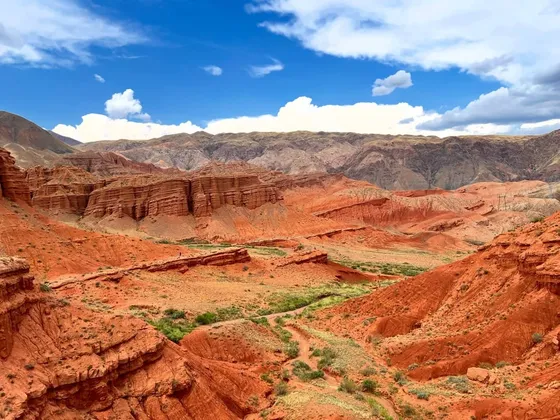
The National History Museum, Oak Park, the Philharmonic, Victory Square and the Wedding Palace all stand within about 1.5 km of Ala-Too Square, so most of central Bishkek can be seen on foot. The Kyrgyz Ala-Too range runs along the southern edge of the city, and its nearest valleys make easy day trips.
We have sorted these 17 things to do into four groups: the squares and parks of the centre, Soviet Bishkek, the bazaars and the Central Mosque, and day trips into the mountains. You can walk between the first ten. For Dordoi Bazaar and the day trips you need a taxi or a marshrutka (minibus).
Three recent changes matter for visitors: Osh Bazaar is due to move to a new site in spring 2027, a number of streets were merged and renamed in 2026, and the long-distance bus stations have moved. We flag each one where it matters. For food and coffee, see our guides to the best restaurants and best cafes in Bishkek.
Map of things to do in Bishkek
Ala-Too Square and the centre
The heart of Bishkek is compact. Start at Ala-Too Square and fan out along the boulevards and parks around it.
1Ala-Too Square
Bishkek’s main square, rebuilt in 2024 and 2025
Ala-Too Square was built in 1984 for the 60th anniversary of the Kirghiz SSR, and it was called Lenin Square until independence in 1991. Its centrepiece has followed the politics: Lenin until 2003, then a winged statue called Erkindik (“freedom”) until 2011, and since then Manas, the hero of the Kyrgyz national epic.
The square closed for a rebuild in April 2024. A 100-metre flagpole replaced the old 45-metre one, and the new flag went up on Independence Day, 31 August 2024. A new and much larger Manas monument by Tamila Mamatova followed in August 2025. With its marble pedestal it stands 33 metres tall.
- Best for
- A first walk around the centre
- Cost
- Free
- Where
- City centreOpen in Maps
Details checked November 2026
View this post on Instagram
2National History Museum and Old Square
The country’s story under one roof, with Lenin round the back
The National History Museum fills the big white building on the north side of Ala-Too Square. It was founded in 1925, moved into this building in 1984 and reopened in late 2021 after a five-year renovation that Turkey helped to pay for.
The galleries run from prehistoric rock art and Saka-era finds to Turkic stone figures, coins and jewellery. Photography has been banned inside, so ask at the desk before you take your phone out.
Then walk round the back to Old Square. The 1984 Lenin statue that once stood on Ala-Too Square was moved here in 2003.
- Hours
- Tuesday to Sunday, 09:00–18:00; closed Monday
- Tickets
- 200 som for adults
- Where
- North side of Ala-Too SquareOpen in Maps
Details checked November 2026
View this post on Instagram
3Erkindik Boulevard
Bishkek’s oldest avenue of trees
Erkindik Boulevard runs for about 2.3 km from the Bishkek-2 railway station north to Zhibek Zholu Avenue, with a shady walkway down the middle. It was laid out in 1883 as an avenue of poplars, and by 1904 oaks had taken their place.
In Soviet times it was Dzerzhinsky Prospect. It took the name Erkindik, meaning freedom, after independence. It crosses Chuy Avenue just east of Ala-Too Square, so it is easy to fit into a walk around the centre.
- Best for
- A shady walk
- Length
- About 2.3 km
- Where
- Runs north from Bishkek-2 stationOpen in Maps
Details checked November 2026
View this post on Instagram
4Oak Park
An old oak grove full of Soviet sculpture
Oak Park sits a block east of Ala-Too Square, in a grove that grew from oaks first planted around 1890. In 1984 the works from an all-Union sculpture symposium were set out under the trees, and the park has been an open-air sculpture museum ever since.
A city upgrade began in summer 2026 and stalled in September with the work unfinished. Some trees and a sculpture were damaged during the work, so expect some disruption until it is done.
- Best for
- Sculpture under the trees
- Where
- A block east of Ala-Too SquareOpen in Maps
Details checked November 2026
View this post on Instagram
5The Philharmonic and Manas Square
Soviet modernism with the national epic out front
The Kyrgyz National Philharmonic was founded in 1936, and its building by the architect A. Pechenkin was finished in 1980. Inside are a main hall with 1,108 seats and an organ hall with 314.
Out front, a 1981 monument shows Manas on his horse Ak-Kula, slaying a dragon. Manas is 6.3 metres tall, the dragon 13 metres long, and they stand on a granite pedestal nearly 15 metres high. The square between Chuy Avenue and the hall has officially been Manas Square since 1995.
- Best for
- Architecture, concerts
- Where
- Chuy Avenue, west of the centreOpen in Maps
Details checked November 2026
View this post on Instagram
6Victory Square
A yurt frame in concrete
Victory Square opened in 1985, for the 40th anniversary of victory in the Second World War, on the site of the old Green Market. The architects V. Lyzenko and V. Bukhaev joined three concrete arches at the top, like the frame of a yurt roof.
Beneath them a statue of a mother holding a bowl waits for her sons to come home, with the eternal flame at her feet. The square is open around the clock.
- Best for
- Soviet memorials
- Cost
- Free
- Where
- Frunze Street, east of the centreOpen in Maps
Details checked November 2026
View this post on Instagram
Soviet Bishkek
The city was called Frunze from 1926 to 1991, and it kept a rich stock of Soviet buildings and mosaics. These are the best places to see them.
7Soviet mosaics
Murals in stone from the 1960s to the 1980s
Soviet-era mosaics still cover facades around Bishkek, though not all of them have made it. In August 2025 Andrei Mikhalev’s 1964 mosaic by the old Frunze airport was taken down when Chingiz Aitmatov Avenue was rebuilt.
Three that were still standing in mid-2026 are easy to find: Labour (1966) on Isanov Street at Chuy Avenue, Lenin Is With Us (1978) on Imanaly Aidarbekov Street (formerly Molodaya Gvardiya Boulevard) at Toktogul Street, and Satar Aitiev’s Path of Enlightenment (1978) on a Kyrgyz National University building, where later parts of the building now hide some of it.
- Best for
- Soviet art, a self-guided walk
- Cost
- Free to see from the street
- Where
- Kyrgyz National University (approximate)Open in Maps
Details checked November 2026
View this post on Instagram
8The Wedding Palace
Bishkek’s most striking Soviet building
Bishkek’s Wedding Palace was designed by A. Klishevich and A. Logunov and finished in 1987. Its sides are lined with folded, accordion-like windows that pull daylight deep into the halls.
It sits a few blocks north-east of Oak Park, so you can pair it with the Frunze Museum and the Fine Arts Museum on the same walk.
- Built
- 1987
- Where
- North-east of Oak ParkOpen in Maps
Details checked November 2026
View this post on Instagram
9Gapar Aitiev Museum of Fine Arts
Kyrgyz art and felt in a 1970s building
The National Museum of Fine Arts opened as a picture gallery in 1935 and moved into its current building, designed by Shailo Djekshenbaev, in 1974. The building is a fine piece of Soviet modernism in its own right.
The collection runs to about 18,000 works, among them some 4,000 paintings and 1,000 sculptures. Look out for the felt ala-kiyiz and shyrdak carpets on the walls. Flash and tripods aren’t allowed.
- Hours
- Tuesday to Sunday, about 10:00–18:00
- Tickets
- About 100 som
- Where
- East of Oak ParkOpen in Maps
Details checked November 2026
View this post on Instagram
10Frunze House-Museum
A Soviet museum that has barely changed
Mikhail Frunze, the Red Army commander the city was named after, was born in Pishpek in 1885. His house-museum on Frunze Street is a period piece in itself, with much of the Soviet display kept as it was.
It is still open and still stages temporary shows. In May 2026 it put the sabre of the last Emir of Bukhara on display.
- Best for
- Soviet interiors
- Where
- Frunze Street, north of Ala-Too SquareOpen in Maps
Details checked November 2026
View this post on Instagram
Bazaars and the Central Mosque
Bishkek does its shopping at two big bazaars, Osh Bazaar west of the centre and Dordoi on the northern edge. The Central Mosque, opened in 2018, stands north-east of the centre.
11Osh Bazaar
The central market, before it moves in 2027
Osh Bazaar is Bishkek’s big central market, a maze of stalls selling bread, spices, nuts, dried fruit, felt slippers and almost everything else. It is open daily, roughly 09:00–19:00. Pickpockets work the crowds, so keep your phone and wallet zipped away.
The state has built a new Osh market west of the centre, with more than 10,000 stalls, and traders are due to move there in spring 2027. The old site will then close and become a park, so see it while you can.
For a sit-down Kyrgyz meal afterwards, Sonoon, behind Ala-Too Square, is our pick.
- Hours
- About 09:00–19:00 daily
- Moving
- To a new site in spring 2027
- Where
- West of the centre, off Chuy AvenueOpen in Maps
Details checked November 2026
View this post on Instagram
12The Central Mosque
An Ottoman-style mosque from 2018
The Imam Sarakhsi Central Mosque was built from 2012, with money from Turkey’s religious affairs directorate, and opened in September 2018. It is modelled on Ankara’s Kocatepe Mosque, with four minarets around a big central dome.
It holds up to 30,000 worshippers, 9,000 of them inside. Dress modestly if you plan to go in, and avoid prayer times.
- Opened
- 2018
- Where
- North-east of the centreOpen in Maps
Details checked November 2026
View this post on Instagram
13Dordoi Bazaar
A city of shipping containers
Dordoi is a wholesale and retail market on the north-eastern edge of Bishkek, a strip more than a kilometre long. It grew from 1992 out of thousands of shipping containers, stacked into lanes of shops, workshops and cafes, and about 70,000 people work there.
It is open daily 09:00–16:00, so go in the morning. Marshrutkas (minibuses) run there from the centre.
- Hours
- 09:00–16:00 daily
- Getting there
- Marshrutka from the centre
- Where
- North-eastern edge of the cityOpen in Maps
Details checked November 2026
View this post on Instagram
Day trips from Bishkek
These four are all within about 80 km of the city. Our guide to day trips from Bishkek has transport, prices and opening hours for each.
14Ata-Beyit
The 1938 memorial where Chingiz Aitmatov is buried
In 1938 the NKVD shot prisoners at Chon-Tash, in the foothills south of the city, and the Ata-Beyit memorial now holds their reburied remains. Chingiz Aitmatov, Kyrgyzstan’s best-known writer, lies here beside his father, who was among the dead. Our day-trips guide covers the 1916 and 2010 memorials, the museum and how to pair the visit with Chunkurchak.
- Best for
- Modern Kyrgyz history
- Where
- About 30 km south of BishkekOpen in Maps
Details checked November 2026
View this post on Instagram
15Ala-Archa National Park
Mountains an hour from the city
Ala-Archa has been a national park since 1976. It protects a valley of juniper and spruce forest below the glaciers of Semenov-Tian-Shansky Peak (4,895 m), the top of the Kyrgyz Ala-Too range, and it is our pick for a first day in the mountains. Our day-trips guide covers the bus, the entry fee, the cable car and the walk to the Ak-Sai waterfall.
- Altitude
- About 1,500 m at the gate, 2,160 m at the alpine camp
- Getting there
- City bus No. 1 or a taxi, about an hour
- Where
- Alpine camp at the end of the park roadOpen in Maps
Details checked November 2026
View this post on Instagram
16Chunkurchak
Gold slopes in autumn, a family ski area in winter
In autumn the slopes of the Chunkurchak valley, about 30 km from central Bishkek, turn gold, and in winter it runs a family-friendly ski area with five chairlifts. It is about 7 km from Ata-Beyit, and our day-trips guide has lift-pass prices and the ethno-resort.
- Best for
- Autumn colour, easy skiing
- Where
- South of BishkekOpen in Maps
Details checked November 2026
View this post on Instagram
17Burana Tower
Balasagun’s last tower, on the UNESCO list
Along with some earthworks, grave markers and the remains of a castle and three mausoleums, the Burana Tower near Tokmok is all that is left of Balasagun, a Silk Road city founded by the Karakhanids. It has been on the UNESCO World Heritage list since 2014, as part of the Silk Roads listing. Tickets, hours and the two-marshrutka route are in our day-trips guide.
- Best for
- Silk Road history, an easy half day
- UNESCO
- World Heritage since 2014
- Where
- Near Tokmok, about 80 km east of BishkekOpen in Maps
Details checked November 2026
View this post on Instagram
More things to do in Bishkek
These didn’t make the numbered list, but they are worth knowing about if you have more time.
- Opera and Ballet Theatre: a 1955 theatre with 853 seats. The season usually runs from late September to June. Buy tickets at the box office or on ticket.kg.
- Panfilov Park: the city’s old amusement park is being done up. Some rides were taken down in 2026, and a renovated amphitheatre opened in October 2026 with concerts planned on Fridays and Saturdays.
- Zhyrgal banya: a public bathhouse on Toktogul Street, with a sauna, an ice-cold pool and separate sections for men and women. Entry was 150 to 300 som in 2024.
- Tumar: an art salon on Isanov Street that sells felt, ceramics and other Kyrgyz crafts.
- Kok-boru: the horseback game played with a goat carcass has no regular schedule near Bishkek. A new 20,000-seat hippodrome with a kok-boru arena is planned for the city.
- Issyk-Ata: a hot-spring resort 78 km from Bishkek at 1,775 metres, with springs at 52 to 54 °C.
Tips for visiting Bishkek
- Trust map pins over street names. Bishkek merged and renamed a number of streets in 2026, and buildings on them are being renumbered. The pins on our map are a safer guide than an old address.
- Check where your bus leaves from. The Western bus station closed on 23 October 2024. Buses to Issyk-Kul, Kochkor and Naryn now leave from the municipal bus station on the eastern bypass road, and buses to Osh, Jalal-Abad and Talas from a temporary stop in the west of the city. A new Western bus station is being built next to the new Osh market, but at the end of September 2026 it still had no opening date.
- Plan museums for Tuesday to Sunday. The National History Museum and the Fine Arts Museum are both closed on Mondays.
- Watch your pockets at the bazaars. Osh Bazaar and Dordoi are crowded, so carry only what you need.
Questions people ask
How many days do you need in Bishkek?
Two days suit most visitors: one for Ala-Too Square, the museums and Osh Bazaar, and one for a day trip into the mountains. Add a third if you want Dordoi Bazaar or a second day trip.
Can you walk around Bishkek?
The centre is easy on foot: the first ten entries on this list are all within about 2 km of Ala-Too Square. For Dordoi Bazaar and anything in the mountains, take a taxi or a marshrutka.
When is Osh Bazaar moving?
Traders are due to move to the new Osh market, west of the centre, in March or April 2027, once the building work is finished. Until then the old bazaar trades daily, roughly 09:00–19:00, and its site will later become a park.
Are Bishkek’s museums open on Mondays?
Both big museums close on Mondays. The National History Museum opens Tuesday to Sunday, 09:00–18:00, and the Fine Arts Museum Tuesday to Sunday, about 10:00–18:00.
Where do buses to Issyk-Kul leave from in Bishkek?
From the municipal bus station on the eastern bypass road, which also serves Kochkor and Naryn. Don’t head for the Western bus station: it shut on 23 October 2024.
What is the best day trip from Bishkek?
For mountains, Ala-Archa, about an hour away on city bus No. 1 or by taxi. For history, the Burana Tower or Ata-Beyit.