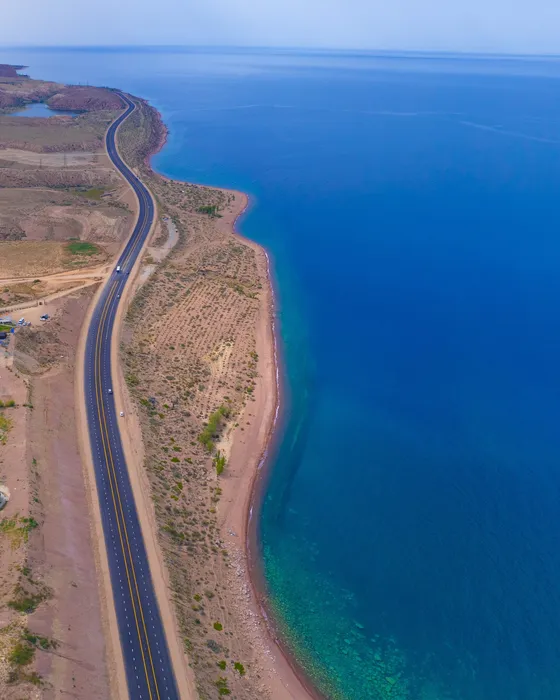
Karakol is the town at the eastern end of Issyk-Kul where most mountain trips in Kyrgyzstan start. It sits at about 1,750 metres under the Terskey Ala-Too, a town of around 84,000 people that began as a Russian garrison in 1869 and was called Przhevalsk for most of the 20th century. The valleys of Karakol national park begin a few kilometres south of the centre.
The town itself fills a day: a wooden cathedral, a mosque built like a Chinese temple, the Sunday animal market and a bowl of ashlan-fu. Give the rest of your time to the mountains, with hot springs at Altyn-Arashan, the turquoise Ala-Kul lake and the red rocks of Jeti-Oguz in summer, and the ski base above town in winter.
We have listed 10 things to do, starting in town, then the valleys and hot springs, then trips further out. For the lake as a whole, see our Issyk-Kul Lake travel guide.
In this guide
Map of things to do in Karakol
In town
Karakol’s sights are close together, and most of the centre is walkable. Give it a day, and make it a Sunday if you can, for the animal market.
1Holy Trinity Cathedral
The wooden church on every Karakol postcard
Holy Trinity Cathedral is the building most people picture when they think of Karakol: a wooden Orthodox church with five green domes, set in a park of tall spruces. It was consecrated in 1895 on the brick base of an earlier church from 1876, which the Chilik earthquake of 1889 brought down. At about 26 metres to the top of its cross, it was once the tallest building in town.
In Soviet times it was closed and stripped of its bell tower and crosses, and for years it was used mainly by a children’s sports school. Restoration began in 1986, and it is a working church again.
There is no ticket. It is open Monday to Saturday 08:00–18:00 and Sunday 08:00–17:00 (2025). Women cover their heads, and scarves are left at the door for anyone without one.
- Entry
- Free (2025)
- Hours
- Mon–Sat 08:00–18:00, Sun 08:00–17:00 (2025)
- Built
- 1895
- Where
- Holy Trinity CathedralOpen in Maps
Details checked November 2026
View this post on Instagram
2Dungan Mosque
A mosque built like a Chinese temple
About a kilometre north of the cathedral, the Dungan Mosque looks more like a temple in Beijing than a mosque in Central Asia, with upturned eaves, a pagoda-style minaret and every beam painted in reds, blues and greens. That was the plan: Ibrahim Aji, a leader of the town’s Dungan community, brought in the Beijing architect Chou Seu and a team of about 20 builders.
It was finished in 1910 and put together without nails, with the beams slotted into grooves. From 1929 to 1947 it was used as a warehouse, and it has been a working mosque again since 1947.
Visitors paid 20 som in 2025 (it may be more in summer), and it is open daily 08:00–18:00. Women cover their arms, legs and head, and hooded coats are handed out at the entrance. It’s best not to visit during Friday prayers.
- Entry
- 20 som (2025)
- Hours
- Daily 08:00–18:00 (2025)
- Built
- 1910, without nails
- Where
- Abdrakhmanova 140Open in Maps
Details checked November 2026
View this post on Instagram
3Ashlan-fu at Bugu bazaar
Karakol’s cold, spicy noodle soup
Ashlan-fu is the dish Karakol is known for all over Kyrgyzstan: a cold Dungan soup of noodles and cubes of starch jelly in a sour vinegar-and-chilli broth, topped with herbs and often strips of omelette. It began as street food, sold mostly by Dungan women on the streets of Przhevalsk in the 1970s, and reached the town’s canteens in the early 1980s.
The place to eat it is the small alley across the street from Bugu bazaar, the small bazaar on the corner of Alybakova and Gagarina, a short walk north of the cathedral. The alley is lined with stalls selling ashlan-fu, salads and manti, and Saida’s stall inside the bazaar is the one with the midday queue. Order it the local way, with a fried potato piroshki on the side.
A bowl cost 90 som at the old bazaar in May 2026. It’s a summer dish, at its best on a hot afternoon. For a sit-down version, Krasny Drakon (Red Dragon) makes five kinds.
- Price
- About 90 som a bowl (May 2026)
- Order with
- A fried potato piroshki
- Where
- Bugu bazaar, Alybakova and GagarinaOpen in Maps
Details checked November 2026
View this post on Instagram
4Sunday animal market
Horses, sheep and haggling before breakfast
Karakol’s livestock market, the mal bazaar, runs on Sunday mornings only, and it is worth planning a weekend around. Herders bring sheep, goats, horses and cattle in from all over Issyk-Kul region, and the market is split into compounds: one for sheep and goats, another for horses, cattle and the odd camel.
The market has moved over the years. It now stands on the M-060 highway on the northern edge of town, about 5.5 km by road from the centre, with the used-car market next door. Some guidebooks still give an older site on Udilov Street; the town’s tourist office points to the highway.
The tourist office gives the hours as 07:00 to 11:00 and says the earlier the better; most of the trading is over by about 10:00. There is no entry fee. A Yandex Go taxi from the centre costs from 70 som (2025). Wear shoes you don’t mind getting dirty.
- When
- Sundays, about 07:00–11:00 (2025)
- Entry
- Free
- Getting there
- Taxi from 70 som (2025)
- Where
- On the M-060 highway, north of townOpen in Maps
Details checked November 2026
View this post on Instagram
Valleys and hot springs
The gorges of the Terskey Ala-Too start just south of town. Marshrutkas to their trailheads leave from the Ak-Tilek bazaar.
5Jeti-Oguz
Red cliffs, a spa village and the Valley of Flowers
Jeti-Oguz is the classic half day out of Karakol: a gorge about 30 km west of town where the river runs past a wall of red conglomerate. The long ridge is the Seven Bulls, which is what the name means, and the split cliff beside it is the Broken Heart. The rocks have been a protected nature monument since 1975.
Above the rocks, the spa village at about 2,200 metres has hot mineral springs of around 41 °C. Its sanatorium, open all year since 1965, was handed to the presidential affairs department in April 2025 and is being rebuilt, with a full reopening planned for 2026, so check it’s open before planning a stay.
For a full day, walk on from just past the Seven Bulls to Kok-Jaiyk, a wide meadow known as the Valley of Flowers, about 3 hours away. Marshrutka 372 leaves Karakol’s Ak-Tilek bazaar every 30 minutes, 07:00–18:30, from 100 som, and a taxi costs about 1,500–2,000 som one way (2025). In summer some buses stop at Jeti-Oguz village, 15 km short, so check the sign says Kurort.
- Best for
- Half a day, or a full day with the walk to Kok-Jaiyk
- Getting there
- Marshrutka 372 from Karakol, from 100 som (2025)
- Distance
- 32 km from Karakol by road
- Where
- The Seven Bulls rocksOpen in Maps
Details checked November 2026
View this post on Instagram
6Ak-Suu hot springs
A hot soak without the trek
If you want a hot soak without the long walk to Altyn-Arashan, Ak-Suu Kench is about 30 minutes east of Karakol, at the old spa village of Ak-Suu, still often called by its Russian name, Teploklyuchenka. It has open-air thermal pools, including pools for children, and it’s open all year.
It charges by the hour: about 300 som an hour in 2026, with the pools open 09:00–23:00. It sometimes closes for repairs, so check before you make the trip.
Marshrutka 350 from the Ak-Tilek bazaar runs to Ak-Suu every 10 minutes from 07:20 and takes about 20 minutes, from 50 som (2025). The track up to Altyn-Arashan starts just past the village, so the pools also make a good last stop on the way back from the mountains.
- Price
- About 300 som an hour (2026)
- Hours
- 09:00–23:00, all year
- Getting there
- Marshrutka 350, about 20 minutes (2025)
- Where
- Ak-Suu KenchOpen in Maps
Details checked November 2026
View this post on Instagram
7Altyn-Arashan
Hot springs at the end of a rough track
Altyn-Arashan is the overnight trip most people make from Karakol: a valley of spruce forest at about 2,400 metres, with hot springs, guesthouses and yurt camps strung along the Arashan river. Palatka peak, 5,020 metres, closes off the head of the valley, and the area is a nature reserve.
Getting there is half the trip. A rough 4x4 track runs about 16 km up from the Ak-Suu side, climbing nearly 700 metres. Walking it takes 4 to 7 hours. The alternative is a seat in one of the old Soviet UAZ vans: about 8,000 som for the whole van one way, or 1,500–3,000 som a seat when shared (2026). The valley is inside Karakol national park, which charges an entry fee at the checkpoint, so carry cash.
The springs come out at up to about 41 °C. Guesthouses have pools in wooden sheds, and two free covered pools sit by the river about 1 km below them. Marshrutka 350 from the Ak-Tilek bazaar towards Ak-Suu passes the turn-off, from 50 som plus 30 som for a big pack (2025). Altyn-Arashan is also where the Ala-Kul trek, below, comes down.
- Best for
- A night in the mountains with a hot soak
- Altitude
- About 2,400 m
- Getting there
- Marshrutka 350, then walk 4–7 hours or take a UAZ
- Where
- Guesthouses in the valleyOpen in Maps
Details checked November 2026
View this post on Instagram
8Ala-Kul lake trek
A turquoise lake at 3,532 metres
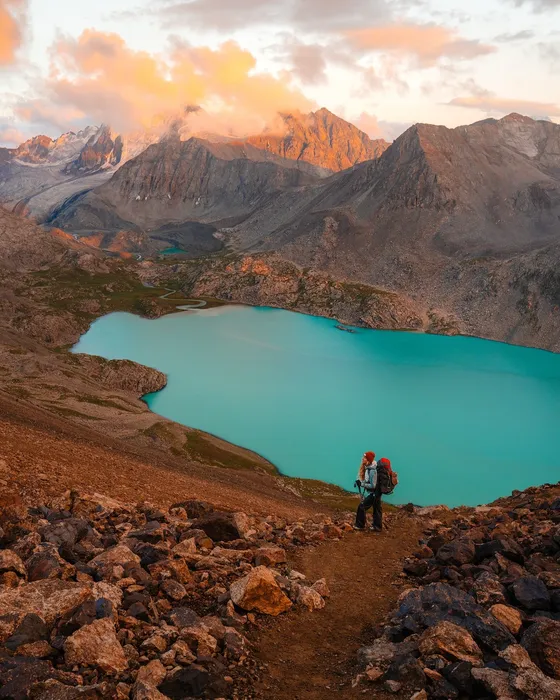
Ala-Kul is the big hike from Karakol: a turquoise lake at 3,532 metres, about 2.8 km long, held back by a natural rock dam high above the Karakol gorge. It is frozen from October to May.
The classic route is a loop of 3 to 4 days and about 55–65 km. Start up the Karakol gorge (marshrutka 101 runs to the national park entrance, and many people take a taxi to the first bridge to save an hour of road), turn up a side valley to the Sirota hut, then climb to the lake. Next comes the pass above it, close to 3,900 metres, and a descent into the Keldike valley. The last day takes you down to Altyn-Arashan and out to Ak-Suu.
Yurt camps in the Sirota and Keldike valleys sell beds and meals in summer. A bed with dinner and breakfast cost 4,200 som in 2025, and the camps fill up in July and August, so book through a Karakol hostel or the tourist office. The season runs from June to early September, and most camps close around mid-September. Karakol national park charges an entry fee at its gates; the amount has varied between 100 and 300 som a person in 2025 and 2026, so carry cash.
- Best for
- A 3–4 day trek with yurt camps
- Altitude
- 3,532 m at the lake, close to 3,900 m at the pass
- Season
- June to early September
- Where
- Ala-Kul lakeOpen in Maps
Details checked November 2026
View this post on Instagram
Further out
Trips that need an early start or a car, and the winter options.
9Karakol ski base
Skiing from December to March
From December to March, Karakol is Kyrgyzstan’s ski town. The ski base is in the mountains above town, 13.5 km by road from the centre, with chairlifts and button lifts serving about 20 km of marked runs between roughly 2,400 metres and 3,040 metres. There’s backcountry terrain beyond the runs, and tandem paragliding flights take off from the slopes in winter.
In 2025/26 a day pass (09:00–16:00) cost 1,400 som Tuesday to Thursday and 1,700 som Friday to Monday, and 2,000 som over New Year. A child’s pass was 1,000 som, plus 300 som for the electronic card, and ski or snowboard rental was 700–900 som a day. Non-skiers could ride up on a 700 som sightseeing ticket. Prices for 2026/27 hadn’t been published by November 2026.
A taxi from town takes 15 to 25 minutes, and many guesthouses arrange a daily 4x4 run up. There’s an ice rink and sledding slopes at the base too. The 2025/26 season opened with Jaryk Fest on 6 December, with free entry, and the organisers plan to hold it every year.
- Season
- About December to March
- Day pass
- 1,400–1,700 som (2025/26)
- Distance
- 13.5 km from town by road
- Where
- Lowest lift stationOpen in Maps
Details checked November 2026
View this post on Instagram
10Jyrgalan valley
Hiking, horses and a new ski resort
Jyrgalan is a former coal-mining village at 2,477 metres, 63 km east of Karakol, that has made itself a base for hiking, horse treks and mountain biking. Guesthouses started opening in 2013, and there are day hikes and longer routes from the village, such as the three-day Boz-Uchuk lakes trek (63 km, June to September).
In winter there’s backcountry skiing, snowmobiling and snowshoeing from November to April. Jyrgalan is also the first zone of the Ala-Too Resort, a large state ski project being built in stages through 2038. Its first phase, with six cable cars and more than 47 km of runs, is due to open on 1 December 2026, so check how far it has got before you plan a ski trip around it.
Marshrutka 331 leaves the Ak-Tilek bazaar at 08:30, 13:30 and 17:30 and takes 1.5 to 2 hours, from 80 som; a taxi costs about 3,500–4,000 som (2025). The road from Karakol is being rebuilt and is busy with construction trucks, so allow extra time.
- Best for
- Quiet hiking in summer, skiing from December 2026
- Distance
- 63 km from Karakol by road
- Getting there
- Marshrutka 331, three a day, from 80 som (2025)
- Where
- Jyrgalan villageOpen in Maps
Details checked November 2026
View this post on Instagram
More things to do in Karakol
A few more ideas for a longer stay, in town and out.
- Przhevalsky memorial: the explorer Nikolai Przhevalsky, who died in Karakol in 1888 and gave the town its old name, is buried on the lakeshore 11.6 km by road north-west of town, under a bronze eagle monument unveiled in 1894. The museum beside the grave opened in 1957 and has about 2,000 exhibits. Entry was from 100 som in 2025, daily 09:00–17:00.
- A day in the Karakol gorge: you don’t have to trek to Ala-Kul to see the gorge. From the national park entrance, a track follows the river through spruce forest and horse pastures, climbing about 650 metres over 16 km to the second bridge, where small cafés sell coffee and snacks. Marshrutka 101 runs to the entrance.
- Walking tours: Destination Karakol, the town’s tourist office, runs a 1.5–2 hour walk through the old town, taking in the Dungan and Tatar mosques, the Russian quarter, Bugu bazaar and the ashlan-fu alley, for 1,500 som a person (2025). Since 2026 it also has an audio walking tour, with actors voicing figures from the town’s past, for 2,000 som. Both need at least three people.
- More Dungan and Uyghur food: beyond ashlan-fu, look for ganfan (laghman sauce over rice, with laza chilli sauce on the side), manti filled with juisai greens, and the fried and boiled styles of laghman. Dishes like hogo, the Dungan hot pot, rarely appear on menus; the tourist office arranges Dungan, Uyghur and Kyrgyz home dinners and cooking classes where you can try them.
- Ak-Tilek bazaar: Karakol’s big central market is where the marshrutkas to the valleys leave from, and it’s worth a wander for dried fruit, nuts, fried fava beans and spices, including around ten kinds of red pepper flakes.
- Karakol zoo: Bugu-Ene, founded in 1987, is the only zoo in Kyrgyzstan. It’s small, at 7.5 hectares, but it’s a chance to see local animals such as wolves, markhor and bears, and a rescued albino kangaroo moved in in 2026.
- Horse treks: three-day rides to Altyn-Arashan and up towards the Ala-Kul pass run from late June to October. Horses are hard to arrange on your own, so book through the tourist office or one of its partner operators.
- The south shore: the Barskoon waterfalls and Skazka canyon are long day trips from Karakol, about 2 hours each way by road.
Tips for visiting Karakol
- Getting there from Bishkek. Day marshrutkas leave Bishkek’s municipal bus station on the northern bypass road through the morning and take 6 to 7 hours, from 500 som. Shared taxis cost 1,000–1,500 som, and night buses leave at 21:00, 22:00 and 23:00 (2025). Asman Airlines also flies Bishkek–Karakol at a fixed fare of 4,000 som (2026).
- Coming from Almaty. A direct bus between Karakol bus station and Almaty started in September 2025, at 1,200 som, and Asman Airlines has flown Almaty–Karakol on Fridays and Sundays since December 2025, from 6,500 som.
- Know the three bus stands. Buses to Bishkek use the main bus station on Przhevalskogo. The Southern bus station, on Toktogul Street, serves the south shore, and marshrutkas to Jeti-Oguz, Ak-Suu and Jyrgalan leave from the Ak-Tilek bazaar. In town, a marshrutka ride is 20 som and Yandex Go taxis are cheap (2025).
- Use the tourist office. Destination Karakol, at Lenina 150, sells trekking maps and books guides, yurt camps and transport, and its staff speak English and Russian. Its hours change with the season, and it’s closed on Sundays.
- Pick your season. June to early September is trekking season, when all the passes are open. Autumn brings colour and fewer people, and the ski base runs from about December to March. Many yurt camps close in mid-September.
- Expect building work. Karakol is in the middle of a big rebuild. The history museum is closed for reconstruction, and the central square, Pushkin Park and many streets are being redone through 2026 and 2027.
Questions people ask
How many days do you need in Karakol?
Two days covers the town and a trip to Jeti-Oguz or the Ak-Suu hot springs. Add a night for Altyn-Arashan, and 3 to 4 more days to trek to Ala-Kul. If you can, be in town on a Sunday for the animal market.
How do you get from Bishkek to Karakol?
By marshrutka from Bishkek’s municipal bus station on the northern bypass road, about 6 to 7 hours from 500 som, or by shared taxi for 1,000–1,500 som (2025). Night buses leave at 21:00, 22:00 and 23:00, and Asman Airlines flies the route at a fixed 4,000 som (2026).
What is Karakol known for?
Its wooden Holy Trinity Cathedral, the Chinese-style Dungan Mosque, ashlan-fu noodles and the Sunday animal market. It’s also the base for treks to Ala-Kul and Altyn-Arashan, and for skiing in winter.
When is the Karakol animal market?
On Sunday mornings only, roughly 07:00 to 11:00 (2025). Go early, as most of the trading is over by about 10:00. It’s on the M-060 highway on the northern edge of town.
Can you ski in Karakol?
Yes. The ski base, 13.5 km from town, runs from about December to March, and a day pass cost 1,400–1,700 som in 2025/26. The new Ala-Too Resort at Jyrgalan, 63 km east, is due to open its first lifts on 1 December 2026.
Do you need a guide for the Ala-Kul trek?
No. In summer many people walk it on their own and sleep in the yurt camps along the way. It is a high route, though, with a pass close to 3,900 metres, so if you’d rather go with a guide or with horses, the tourist office in Karakol can book one.